
Most briefs I’m handed are very precise about two things: the nutrient and the dose. The form is usually left as a detail to sort out later, or picked because it sounds impressive on the label. Picked badly, it costs more than the ingredient ever will.
The form a nutrient takes decides whether it survives the journey into your bloodstream, and whether it sits quietly in your gut or sends you running. It is a formulation decision long before it is a marketing one, and the two pull against each other more often than anyone likes to admit.
This matters on both sides of the shelf. If you build supplements, it is a way to spend your budget where it actually changes the product. If you buy them, it is a way to tell when a premium form is worth the money and when you are paying for a longer word on the panel.
What “bioavailability” actually means
Bioavailability is the share of a nutrient that makes it into your bloodstream and gets used. It sounds simple, but the label rarely shows you the number that decides it.
“Less absorbed” rarely means “useless”. Two numbers decide how much nutrient you get, and the premium forms only win one of them.
- Absorption fraction: the percentage of what you swallow that crosses into the body. Chelated and “active” forms usually score higher here.
- Elemental density: how much of the mineral is packed into each milligram of the compound. Cheap oxide forms often win this one by a wide margin.
Magnesium oxide is the classic example. Its absorption fraction is low, yet it carries so much elemental magnesium per pill that the net amount delivered can close much of the gap. What matters is whether a form delivers enough of the nutrient in a version this person can tolerate, at a price the product can carry. A lab absorption ranking tells you none of that.
When the premium form is just a label
Walk down any supplement aisle and you see the same move: the fancier-sounding form gets called premium and priced to match. Sometimes that premium buys real performance. Often it just buys a longer, Latin-looking name.
Vitamin B12: methyl vs cyano
Methylcobalamin reads better than cyanocobalamin and costs more. In most people the two absorb at nearly the same rate, and cyanocobalamin is more stable on the shelf and far cheaper to source. There are good reasons to choose methyl, like vegan sourcing or clean-label positioning. Raw absorption usually isn’t one of them. If you are paying a multiple for the methyl form and your only reason is “it absorbs better”, you are paying for the word.
Folate: folic acid vs L-5-MTHF
Synthetic folic acid is cheap and extremely stable, and it absorbs well on an empty stomach, often above 90%. L-5-MTHF earns its place when you formulate for people with MTHFR gene variants, who convert folic acid slowly. For that audience it is genuinely the smarter pick. In a general multivitamin aimed at the whole market, folic acid still does the job for most people.
Vitamin B6: P5P vs pyridoxine
P5P (pyridoxal-5-phosphate) is sold as the “active” form, while plain pyridoxine is framed as needing an extra conversion step. In practice, P5P has to be de-phosphorylated before it can be absorbed, then rebuilt inside your tissues anyway. Both forms end up doing the same work. P5P can be a reasonable choice, but the “it skips a step” story is mostly marketing.
When the premium form pays off
The opposite case is just as common, and this is where cutting cost kills a product. Nobody notices until the reorder numbers come in flat.
Iron: bisglycinate vs sulfate
Ferrous sulfate is effective and cheap, which is why it fills the budget shelf. It also causes enough nausea and constipation that a lot of people quit in the first couple of weeks. Ferrous bisglycinate costs more per dose and sits far better in the gut. For a women’s health or prenatal line, the chelated form is often what keeps someone on the product long enough to see a result, and long enough to reorder. The cheaper form can end up costing you the customer.
Magnesium: oxide vs bisglycinate or citrate
Oxide has very high elemental density, so you can print a big number on the label with a small pill. The absorption fraction is low, though, and at that dose its most reliable effect is laxative. For a sleep or recovery product, bisglycinate or citrate deliver more usable magnesium and are gentler on digestion. Oxide belongs in the formula only when the laxative effect is the point, as in some constipation products.
Zinc: chelate vs oxide
Zinc oxide is poorly soluble and easily bound by phytates, the natural compounds in grains and legumes. On a plant-heavy diet, a good chunk of that zinc never gets absorbed. Chelated forms like bisglycinate or picolinate are more reliable, which matters most for a vegan or wholefood-oriented product. In a formula aimed at omnivores, oxide is less of a problem, though still not the strongest choice.
Vitamin E: natural vs synthetic
Natural vitamin E (d-alpha, sometimes written RRR-alpha-tocopherol) is retained in the body noticeably better than the synthetic version (dl-alpha). Your liver’s transport proteins prefer the natural isomer, so more of it stays in circulation. Here the premium label reflects a real difference, and for an antioxidant or skin-and-heart product it is usually worth paying for.
Vitamin D and K2: the forms worth getting right
Vitamin D: D3 vs D2
This one is barely a debate. D3 (cholecalciferol) is significantly better than D2 (ergocalciferol) at raising and holding your blood levels of vitamin D over time. A meta-analysis of randomized trials found D3 clearly more effective at lifting serum 25(OH)D. Unless you specifically need a plant-derived D2 for a vegan claim, D3 is the default for almost every product.
Vitamin K2: MK-7 vs MK-4
Both are active in the body, but they behave very differently. MK-4 has a short half-life, so it clears from the blood within hours. MK-7 stays in circulation far longer, which means a single daily dose keeps levels steady around the clock. For a once-a-day bone or heart formula, MK-7 is the more practical choice.
Match the form to the category
The same nutrient doesn’t call for the same form in every product. The category sets the brief, and the brief changes everything.
- Prenatal and women’s health: tolerance and adherence come first. Gentle iron (bisglycinate) and the right folate form matter more than shaving cents.
- Senior and low-acid formulas: calcium citrate beats carbonate, because it doesn’t depend on the strong stomach acid that many older adults and antacid users no longer have.
- Compact daily multivitamins: calcium carbonate is dense and absorbs fine with food, so it earns its place when room in the tablet is tight.
- Vegan and wholefood products: skip zinc oxide, choose a chelate, and lean on forms that don’t get blocked by phytates.
- Sleep, stress and recovery: magnesium bisglycinate or citrate, never oxide, unless you want a laxative on your hands.
Before you lock a form, work backward from the person who will take it. Ask what their gut will tolerate, and where the dose needs to land to do anything at all. Then check what the category expects at that price point. The right answer usually sits in the middle, and it is almost never the most expensive form on the shelf.
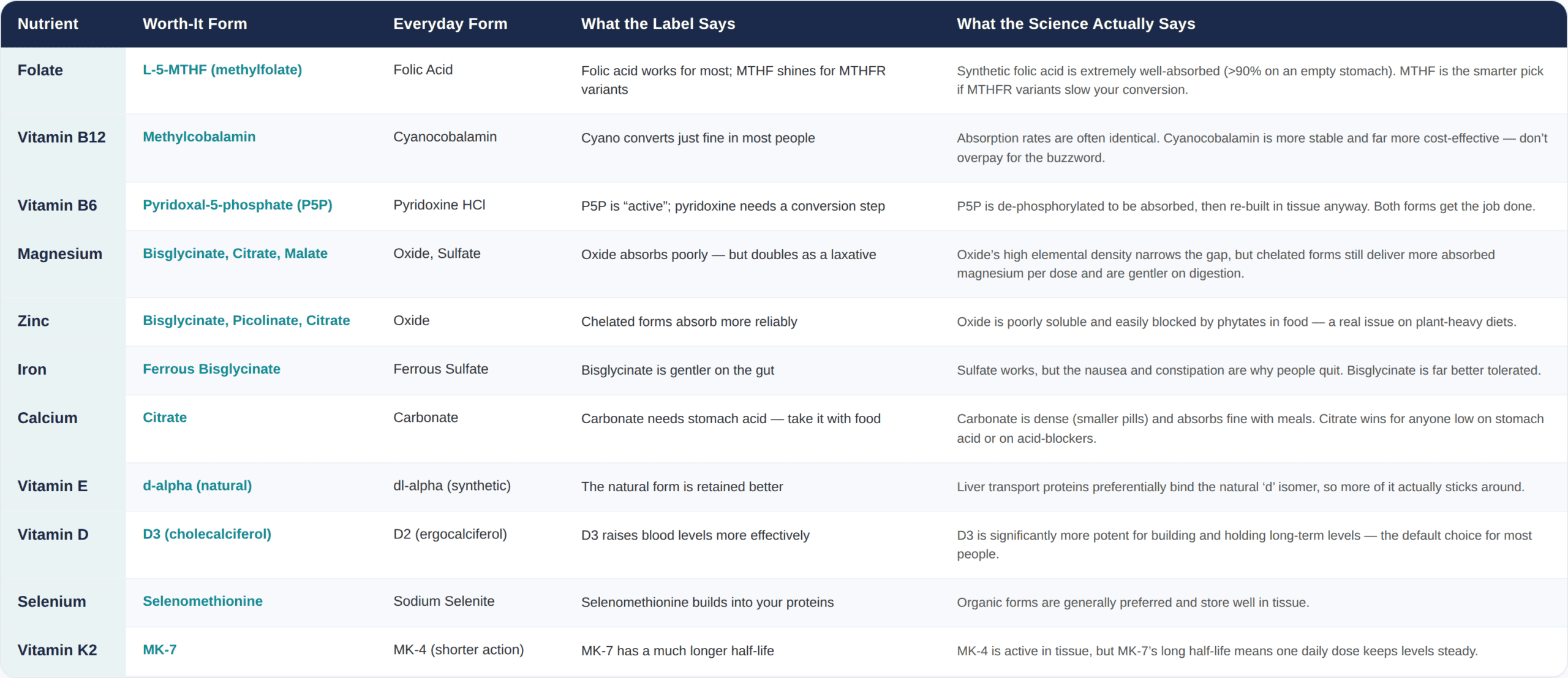
A small plus to keep, whether you formulate supplements or simply buy them: open the table to read it in full, or download it and keep it on hand as a reference.
How to read a supplement label in 30 seconds
You don’t need a chemistry degree to spot a smart formula. A few quick checks tell you most of what you need:
- Find the form in brackets after each nutrient, not just the nutrient name. “Magnesium (as bisglycinate)” tells you far more than “Magnesium 300mg”.
- For minerals you want absorbed gently, look for chelated forms (bisglycinate, citrate) rather than oxide or sulfate.
- For vitamin D, check it says D3. For K2, look for MK-7.
- Don’t assume the pricier form is better. For B12, and for most people folate, the cheaper form performs just as well.
- Read the elemental amount, not just the compound weight, especially for magnesium, iron, zinc and calcium.
Frequently asked questions
Does a better-absorbed form always mean a better product?
No. A form with a lower absorption percentage can still deliver plenty of the nutrient if it carries more of it per pill, like magnesium oxide. Absorption is only half the maths. What actually reaches your blood, and whether you can take it comfortably, is what counts.
Is folic acid a worse choice than methylfolate?
For most people, no. Folic acid is well absorbed and very stable. Methylfolate is the better option mainly for people with MTHFR variants who convert folic acid slowly. If that is not you, the cheaper form is usually fine.
Why does my magnesium send me to the bathroom?
You are probably taking magnesium oxide, or citrate at a high dose. If you want magnesium for sleep or stress rather than for its laxative effect, switch to bisglycinate, which is far gentler on the gut.
D2 or D3, which should I take?
D3 for almost everyone. It raises and holds your vitamin D levels more effectively. Choose D2 only if you specifically need a plant-based form.
The short version
Form is half the formula. Match it to the person and the category, and the product absorbs properly and earns a second purchase. Pick it to save a few cents in the wrong place, and you can lose the customer before they ever feel a thing. Whether you make supplements or simply take them, the form in brackets tells you most of what you need to know.
⚠️ This article is for informational purposes and does not replace the advice of a doctor or healthcare professional. Always consult a qualified professional before making significant changes to your supplements or stopping any ongoing treatment.
Scientific sources
- Tripkovic, L. et al. (2012). Comparison of vitamin D2 and vitamin D3 supplementation in raising serum 25-hydroxyvitamin D status: a systematic review and meta-analysis. American Journal of Clinical Nutrition, 95(6), 1357-1364.
- Sato, T., Schurgers, L.J. & Uenishi, K. (2012). Comparison of menaquinone-4 and menaquinone-7 bioavailability in healthy women. Nutrition Journal, 11, 93.
- Pietrzik, K., Bailey, L. & Shane, B. (2010). Folic acid and L-5-methyltetrahydrofolate: comparison of clinical pharmacokinetics and pharmacodynamics. Clinical Pharmacokinetics, 49(8), 535-548.
- Walker, A.F. et al. (2003). Mg citrate found more bioavailable than other Mg preparations in a randomised, double-blind study. Magnesium Research, 16(3), 183-191.
- Coplin, M. et al. (1991). Tolerability of iron: a comparison of bis-glycino iron II and ferrous sulfate in the treatment of iron deficiency in pregnant women. Clinical Therapeutics, 13(5), 606-612.