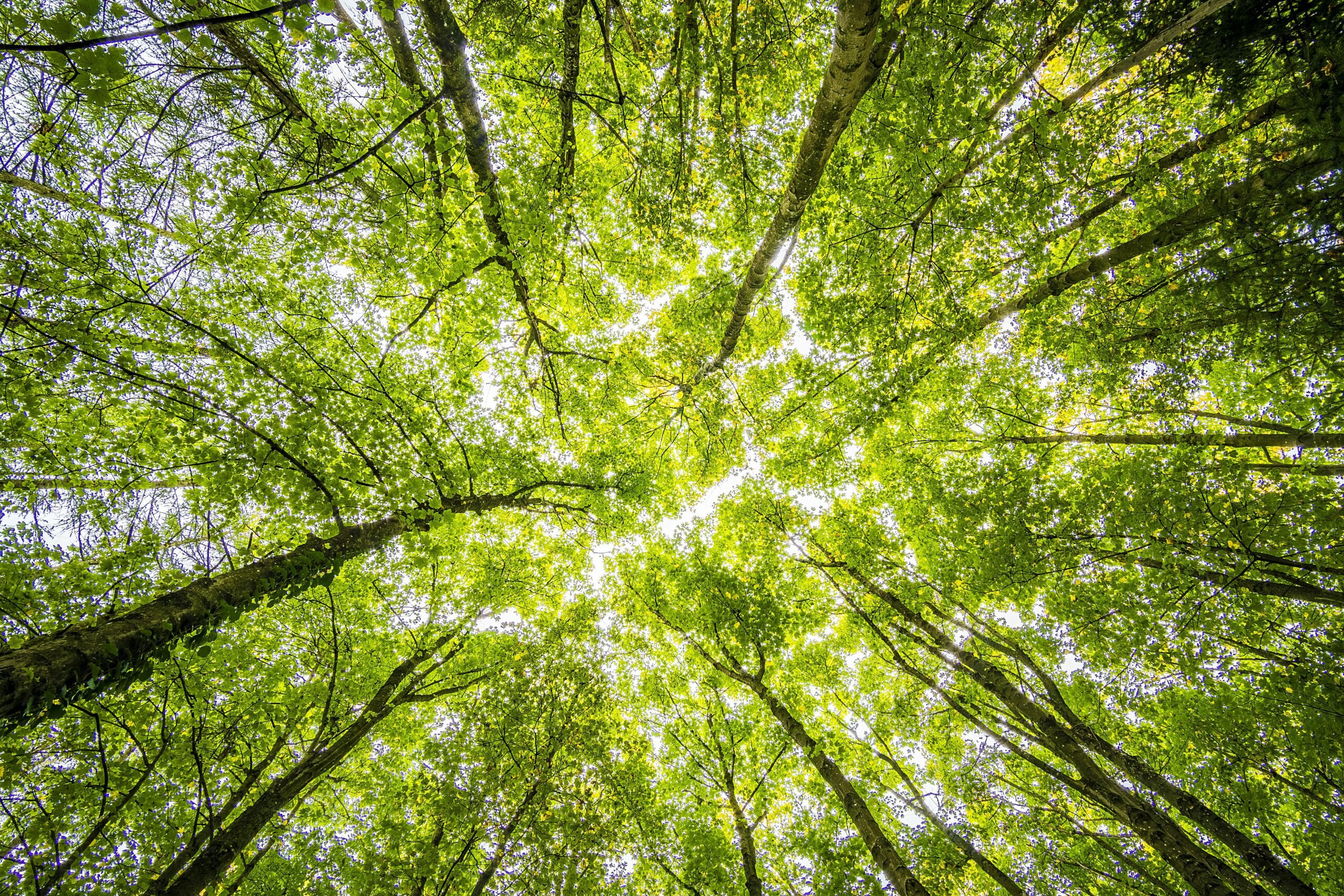
The last time I felt truly at peace, I wasn’t on a mat, I wasn’t meditating, and there was no incense burning. I was simply standing among the trees, my shoes caked in wet earth and the scent of resin filling my lungs.
No mantra and no technique. Just the forest.
And in that silence, something switched off in my head. That constant hum, that endless to-do list, that thin thread of anxiety that follows you around even when “everything’s fine”.
It was simply gone.
If you recognise that feeling, or if you can’t even picture standing still in a wood without checking your phone, this article is for you.
The “forest bath” that science takes very seriously
Shinrin-yoku literally means “forest bathing”. And no, it has nothing to do with trekking, power-walking or the usual Sunday hike.
It’s something else entirely.
It’s a slow, conscious sensory immersion in the atmosphere of the woods. With no destination and nothing to count. Just you and the trees.
The practice was born in Japan in 1982, when the Ministry of Agriculture introduced it as a form of preventive medicine to answer the stress epidemic of urban life. Today there are over 60 certified “therapeutic forests” across Japan, and the practice has spread around the world, Europe included.
But the real question is a different one: why does it work?
The answer hides in a word that sounds almost magical yet is pure biochemistry: phytoncides.
As a former biologist, my first instinct is always the same: go and find the data. And with shinrin-yoku, the data is plentiful, and surprising.
What are phytoncides?
Phytoncides are volatile organic compounds that trees release as a defence mechanism. Among the main ones are the terpenes: alpha-pinene (that unmistakable pine scent), limonene, camphor and beta-caryophyllene.
When you walk through a wood, you’re doing far more than “getting some fresh air”.
You’re literally inhaling an open-air pharmacy.
What the research says
Since 2004, hundreds of studies have been published on the effects of shinrin-yoku. Here are the findings that struck me most:
- A stronger immune system: some early studies suggest that exposure to the phytoncides trees release can raise the activity of NK (Natural Killer) cells¹, which are central to immune defence. A recent meta-analysis backs this up, with positive effects observed on NK cells, T-cells and cytotoxic molecules, both in forest settings and indoors4.
- Cortisol down: walking in a forest, compared to an urban setting, can lower certain physiological stress markers, such as salivary cortisol and some catecholamines2.
- A calmer nervous system: forest bathing has been linked to greater activity in the parasympathetic nervous system, the branch behind relaxation, alongside shifts in heart rate and blood pressure3.
- Effects that last: this is the finding that amazed me. A single weekend of forest bathing can keep NK cell activity elevated for over 30 days1.
The key terpenes and what they do
| Terpene | Where you find it | What it does |
|---|---|---|
| Alpha-pinene | Pines, firs, rosemary | Anti-inflammatory, lowers stress, improves sleep |
| Limonene | Citrus, conifers | Lifts mood, steadies blood sugar, supports digestion |
| Beta-caryophyllene | Black pepper, cloves | Anxiolytic, interacts with the endocannabinoid system |
| Camphor | Camphor tree, rosemary, sage | Decongestant, boosts circulation |
The holistic view: the forest as sacred space
Science explains the how. Ancient traditions explain the why.
In almost every indigenous culture, the forest is far more than an ecosystem.
It’s a living, conscious organism.
Amazonian shamans speak with the spirits of the trees. Celtic druids held oak groves as sacred temples. In Japan, the Shinto tradition sees in great trees the presence of kami, the spirits of nature.
You don’t have to believe in anything in particular to sense this dimension. You just have to slow down enough to feel.
So let’s look at how the forest works on an energetic level:
- Grounding (Muladhara): contact with the earth and with the roots of the trees reawakens the first chakra, the centre of stability and safety. The same principle we explored in the 5 yoga poses to ground a racing mind.
- An open heart (Anahata): green is the colour tied to the heart chakra. Immersion in green does more than relax you; it works on your capacity for compassion, connection and openness.
- Clearing the energy field: the way smudging cleanses a space through smoke, the forest cleanses your energy field through the air you breathe. In a sense, phytoncides are nature’s own “sacred smoke”.
Sciamanoverde tip: connect your breath to the breath of the trees. As you exhale carbon dioxide, they turn it into oxygen and release phytoncides, which you draw back in. It’s a real exchange, measurable and deeply intimate. Forest bathing is one of the purest forms of reciprocity with the living world.
How to practise Shinrin-yoku: a 5-step guide
You don’t need gear, apps or instructors. You need a wood and the willingness to slow down.
1. Choose your forest
It doesn’t have to be the Amazon. An urban park with trees, a hillside path, a copse just outside town. What matters is that there are real trees.
Conifers like pines, firs and cypresses are especially rich in phytoncides, but oaks, beeches and chestnuts pull their weight too.
2. Leave the phone behind
Or at least put it in airplane mode. This is the hardest step for most of us.
But as we explored in the piece on digital detox and the mind that won’t switch off, the brain needs empty spaces to regenerate. The forest is that space, but only if you let it be.
3. Slow down. Really.
Shinrin-yoku is an aimless wander, not a hike with a finish line.
Walk slowly, much more slowly than feels natural. Stop often. Sit. Stay. There’s nowhere you need to get to.
The ideal is at least 2 hours, but even 20 conscious minutes beat nothing by a mile.
4. Switch on all your senses
This is the heart of the practice. One at a time, bring your attention to each sense:
- Sight: notice the shades of green, the light filtering through the leaves, the play of shadow on the ground.
- Hearing: birdsong, the rustle of leaves, the silence between one sound and the next. That silence matters as much as the sounds.
- Smell: breathe in deeply. Resin, wet earth, moss, decaying leaves. Every scent is a phytoncide working for you.
- Touch: run your hand over the bark of a tree. Feel the moss under your fingers. If you can, slip off your shoes and rest your bare feet on the earth.
- Taste: if you know your wild plants, taste a leaf of wild mint or a sprig of rosemary. Otherwise, bring a thermos of warm infusion and sip it sitting on a log.
5. Sit with a tree
Choose a tree that draws you in. Don’t overthink it, go toward the one that “calls” you.
Sit with your back against the trunk. Close your eyes. Stay for at least 15 minutes.
It sounds simple. It is simple. But the simplicity is the whole point. There’s nothing to “do”. Only to be, in a place that existed long before you and will carry on long after.
Shinrin-yoku vs. a walk in the green: not the same thing
If you’re thinking “but I already go for walks in the park”, hold on. It’s not the same thing. Here’s why:
| Aspect | A walk in the green | Shinrin-yoku |
|---|---|---|
| Goal | Physical exercise, fresh air | Sensory immersion, deep regeneration |
| Pace | Moderate to fast | Very slow, with frequent pauses |
| Attention | Often distracted (podcast, chat, thoughts) | All senses switched on, full presence |
| Ideal duration | 30 to 60 minutes | 2 to 4 hours |
| Effect on NK cells | Slight increase | Increase lasting 30+ days |
| Effect on cortisol | Moderate reduction | Marked reduction |
The whole difference lives in intention and presence. You can walk through a wood for an hour and not “bathe” in it at all.
When there’s no forest: bringing it home
Not everyone lives near a wood. You don’t always have 2 hours. I know. Here are a few alternatives that genuinely work:
- Conifer essential oils: diffusing Scots pine, silver fir or cypress essential oil recreates part of that phytoncide atmosphere. Some studies confirm that inhaling phytoncides indoors also raises NK cell activity4. The indoor effect is generally weaker and less studied than the forest itself, though.
- Houseplants: ferns and ficus release beneficial volatile organic compounds and improve air quality.
- Forest sounds: apps like Insight Timer offer beautiful forest soundscapes you can layer under meditation or work.
- Urban micro-forest bathing: even 20 minutes in a tree-lined park gives you measurable benefits. Don’t underestimate the small gestures.
Sciamanoverde tip: build your own weekly ritual. Even once a week, find “your” tree, the one in the park downstairs, the one along the route you always take, and go sit with it. Bring a thermos of calming lemon balm infusion and turn those 20 minutes into a sacred appointment with the earth. Is it a little? Maybe. But it’s infinitely more than zero!
The forest is in no hurry. Are you?
We live in an age that asks us to be fast, connected and productive at all times. And the body answers however it can: high cortisol, broken sleep, a tired immune system, a mind that never switches off.
The forest asks nothing of you.
It doesn’t judge you for not being flexible enough, for not meditating “the right way”, for failing to empty your mind. It doesn’t ask you to buy anything, sign up for anything, or be different from who you are.
It only asks you to step in. To slow down. To breathe.
And in return, it offers something no app, no supplement and no technique will ever fully replicate: the memory, written into your DNA, that you are nature. Not separate from it. Not visiting. Part of it.
Maybe you don’t have 2 hours today. Maybe there’s no wood on your doorstep.
But there’s a tree, somewhere. Go and find it.
Scientific references
- Li, Q. (2010). Effect of forest bathing trips on human immune function. Environmental Health and Preventive Medicine, 15(1), 9-17. https://doi.org/10.1007/s12199-008-0068-3 (PubMed: https://pubmed.ncbi.nlm.nih.gov/19568839/)
- Li, Q. (2022). Effects of forest environment (Shinrin-yoku/Forest bathing) on health promotion and disease prevention, the Establishment of “Forest Medicine”. Environmental Health and Preventive Medicine, 27, 43. https://doi.org/10.1265/ehpm.22-00160 (PMC: https://pmc.ncbi.nlm.nih.gov/articles/PMC9665958/)
- Li, Q. (2025). Preventive Effects of Forest Bathing/Shinrin-Yoku on Cardiovascular Diseases: A Review of Mechanistic Evidence. Forests, 16(2), 310. https://doi.org/10.3390/f16020310 (MDPI: https://www.mdpi.com/1999-4907/16/2/310)
- Lew, T., & Fleming, K. J. (2024). Phytoncides and immunity from forest to facility: A systematic review and meta-analysis. Pharmacological Research – Natural Products, 4, 100061. https://doi.org/10.1016/j.prenap.2024.100061 (ScienceDirect: https://www.sciencedirect.com/science/article/pii/S2950199724000491)
The information in this article is for informational purposes only and does not replace the advice of a doctor or healthcare professional. Shinrin-yoku is a complementary practice: if you have specific medical conditions, always consult your doctor.